
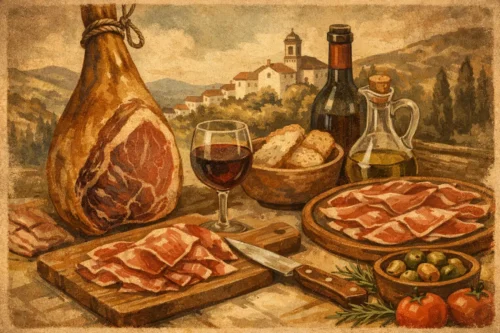
Serrano Ham: How to Choose It and Enjoy It
Learn how to choose Serrano ham by curing time, format, and label, how to store it at home, and how to serve it at its best—from Andalusia to your table every day.
Andalusia arrives at all of Spain France Portugal Germany Belgium Italy Croatia Croatia Rep. Czech Republic Slovakia Netherlands Hungary Poland Austria Slovenia Romania Bulgaria Greece Ireland Luxembourg United Kingdom
Serrano ham doesn’t need a special occasion to shine. A few well-cut slices, served at the right temperature and accompanied by good bread, can make the perfect appetizer, a light dinner, or that gourmet gift that tastes like Spain. But not all cured hams are the same: understanding what the label tells you helps you make an informed choice and enjoy each piece the way it deserves.
Serrano ham comes from the hind legs of white pigs, which undergo a process of salting, drying, and curing. Its name refers to the traditional method of curing it in mountainous areas, where dry air and temperature changes favored slow maturation. Today, conditions are carefully controlled, but the principle remains the same: time, salt, temperature, and craftsmanship.
It is worth distinguishing it from Iberian ham. Serrano ham is made from white pigs, while Iberian ham comes from pigs of the Iberian breed or from crossbred animals that meet the applicable regulations. Neither is automatically better for every palate: Iberian ham tends to have more marbled fat and a more intense flavor, while a good Serrano ham offers a clean, balanced taste that is equally enjoyable on its own or in cooking.
There are also differences between a shorter-cured ham and one that has been aged for longer. The longer the curing process, the more moisture the ham loses and the more concentrated its aromas become. This generally results in a firmer texture and a more pronounced salty note, although the final result depends on both the quality of the raw material and the curing process. That is why the curing time can be a useful guide, but it does not tell the whole story.
The first question shouldn’t be which one looks the best, but what it will be used for. For a simple charcuterie board or for serving in thin slices, look for ham with a pleasant aroma, glossy fat, and a juicy texture. For sandwiches, toast, croquettes, or cooked dishes, pre-sliced ham or diced pieces may be more practical and avoid buying a whole leg that may not be eaten in time.
On the label, look carefully for the type of product, weight, best-before date, and storage conditions. If it carries a protected geographical indication or a recognized designation, it provides additional information about its origin and production method. It doesn’t replace personal taste, but it does offer a guarantee of traceability and compliance with specific production standards.
Appearance also tells you a lot. The outer fat should range from white to yellowish in color, never looking rancid or excessively dry. In the sliced ham, the color can vary from pink to deep red. A slight presence of fat marbling is desirable: it adds richness and helps the flavor linger on the palate. If the ham looks dry or dull, or has a strong, unpleasant smell when you open it, it is not at its best.
As a gift, a beautifully presented whole ham works very well if the recipient has a ham stand and enjoys slicing it themselves. If you’re looking for a more straightforward option, pre-sliced packs are a safe bet. They allow you to put together a charcuterie board without any special equipment, are easy to transport, and fit perfectly into a gourmet gift basket alongside cured cheese, olives, breadsticks, preserves, and a bottle of wine or Andalusian fortified wine.
Each format has its own advantage. A whole ham preserves its character better for weeks when properly sliced and protected, and makes serving it part of the experience. On the other hand, it requires space, a stable stand, a suitable knife, and a little patience.
Boneless ham is convenient for slicing at home with a slicer or knife, especially if it is consumed regularly. Vacuum-packed sliced ham offers speed and portion control. It is ideal for smaller households, gift deliveries, and food service operations that need to serve quickly. Choosing it does not mean compromising on quality; it simply means matching your purchase to your actual rate of consumption.
A medium-cured Serrano ham is usually a versatile choice. It has a tender bite, a moderate salty profile, and pairs well with bread, grated tomato, extra virgin olive oil, and fresh fruit. It is an excellent option for breakfast, everyday tapas, and recipes where the ham complements the dish without overpowering it.
Longer curing times produce deeper aromas, with hints of nuts and cellar-aged notes. They are particularly well suited to serving on their own, sliced very thinly, as this allows you to appreciate all the nuances. Here’s a useful rule of thumb: the more character the ham has, the simpler its accompaniments should be. A good extra virgin olive oil, some crisp breadsticks, or a well-served fino sherry may be all you need.
The salt level varies between producers and batches. If you prefer a milder profile, it’s best not to base your choice solely on the price or curing time. Reading the product description and choosing trusted producers is more useful. When buying for several people, it makes sense to opt for a well-balanced ham and leave the more intense profiles for those who already know their preferences well.
The main enemy of ham is poorly managed exposure to air, not cold temperatures alone. A whole ham should be kept in a cool, dry, well-ventilated place, away from direct sunlight and sources of heat. After slicing, cover the exposed area with a little of its own white fat, then with a clean cotton cloth. There is no need to wrap it airtight.
If it is a vacuum-packed pack of sliced ham, follow the manufacturer’s storage instructions. Once opened, consume it promptly and keep it properly covered in the refrigerator. Before serving, take it out in advance to allow it to come back to room temperature. Cold temperatures firm up the fat and mute the aromas; serving it straight from the fridge is one of the most common mistakes.
With diced ham or trimmings, storage requires particular care because they have more exposed surface area. They are excellent for scrambled eggs, sautéed artichokes, broad beans with ham, or hearty legume stews, but it is best to use them promptly after opening the package. Their purpose is to add intensity, not to be forgotten at the back of the refrigerator.
To fully appreciate the ham’s flavor, serve it at a slightly warm room temperature, around 20–24°C (68–75°F). The fat should look slightly glossy and feel supple. If the slice breaks easily, it may be too cold or may have been cut too thick.
Thin slicing is not just a matter of aesthetics. It allows the fat to melt naturally and ensures that the saltiness, aroma, and texture reach the palate in balance. When serving a whole ham, slice only as much as you plan to serve. This prevents a plate prepared too far in advance from losing its shine and drying out.
Don’t discard the pieces close to the bone or the trimmings. When put to good use, they add remarkable depth to broths, lentils, rice dishes, and sofritos. Andalusian cuisine has a strong tradition of making the most of every ingredient: every part has its place, from the most attractive slices for an aperitif to the bone, which can add depth to a homemade recipe.
The most classic pairing still works because it lets the product shine: crusty bread, ripe tomato, extra virgin olive oil, and ham. If the tomato is at its best, simply grate it and add a pinch of salt. For a fresher option, try pairing it with melon, figs, pear, or grapes. The fruit softens the saltiness and refreshes the palate between slices.
For a sharing platter, combine different textures without filling the plate with too many elements competing for attention. A cured sheep’s cheese, seasoned olives, toasted almonds, and breadsticks are enough to complement the ham. If you add a preserved delicacy, choose a high-quality one and serve it separately: anchovies or tuna belly can pair beautifully with the ham, but each product deserves its own moment in the spotlight.
For food service, Serrano ham makes it possible to create recognizable and profitable tapas, as long as attention is paid to portion size and presentation. A toast doesn’t need a mountain of ham; it needs good bread, the product served at the right temperature, and a well-balanced portion. In gourmet shops, pre-sliced packs are also an easy option to recommend to customers who want to take home an authentic taste of Spain without any hassle.
At Andalubox, ham can be part of a much broader selection of Andalusian pantry staples and Spanish products for home, gifting, or business. The key is to choose the format that suits the occasion, check availability, and complete your order with complementary products that make sense.
A good ham doesn’t require elaborate rituals. It simply needs time to come to the right temperature, an honest cut, and a table ready to share it. With that, a well-chosen slice can bring a little of the mountains, the cellar, and Andalusian hospitality to any corner of Spain or Europe.
TE PUEDE INTERESAR
Learn how to choose Serrano ham by curing time, format, and label, how to store it at home, and how to serve it at its best—from Andalusia to your table every day.