
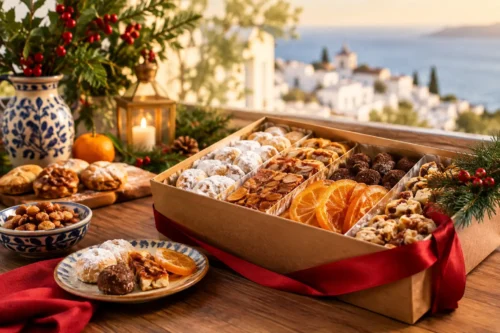
Regional Christmas sweets to give as gifts
Choose from a selection of Spanish regional Christmas sweets, including Andalusian recipes, local specialities and ideas for delicious combinations to share at festive gatherings.
Andalusia arrives at all of Spain France Portugal Germany Belgium Italy Croatia Croatia Rep. Czech Republic Slovakia Netherlands Hungary Poland Austria Slovenia Romania Bulgaria Greece Ireland Luxembourg United Kingdom
As the festive season approaches, regional Christmas sweets bring much more than just a touch of sweetness to the table: they tell the stories of towns, family-run bakeries and recipes that reappear every year in Spanish homes. Giving or serving these treats means offering a generous selection, easy to share after a meal, with coffee or during a cosy get-together.
In Spain, festive treats do not form a uniform category. From one province to the next, the textures vary, as do the flavours: crumbly pastry, dried fruit, honey, sesame seeds, chocolate or citrus fruits. To put together a gourmet gift or a festive spread with real character, the best approach is to vary the origins and the flavours.
Traditional Spanish sweets and biscuits have a life of their own. Some recipes are inextricably linked to the festive season, whilst others are enjoyed all year round but hold a special place at this time of year. They are often sold individually or in assortments, making them handy for entertaining without any preparation.
Their appeal also lies in their diversity. A melt-in-the-mouth mantecado offers a different experience to a dense almond turrón, or a fragrant alfajor. Bringing together a selection of specialities means you can satisfy both those who love bold flavours and those who prefer delicate textures. It’s a good solution when you don’t know exactly what the person you’re trying to please prefers.
When it comes to gifts, regional origins add a more personal touch. A sweet treat chosen for its connection to Seville, Cádiz, Alicante or Toledo becomes a little invitation to a gastronomic journey. For professionals, these specialities can also enhance an end-of-year selection at the counter, in a delicatessen or served alongside a coffee.
Mantecados and polvorones are among the most eagerly anticipated treats of the Spanish festive season. Estepa, in the province of Seville, is particularly closely associated with this tradition. Their sandy, crumbly texture is instantly recognisable, with a melt-in-the-mouth quality that goes perfectly with a coffee, a cup of black tea or a herbal tea.
The two specialities are similar, but are not enjoyed quite in the same way. Mantecado usually has a dense, soft texture, whilst polvorón is even more delicate and crumbly. They come in various versions, including those with dried fruit, cocoa, cinnamon or lemon, depending on the recipe. Ideally, they should be served as an assortment so that everyone can compare the flavours.
The fact that they are individually wrapped is also a real bonus on a festive table. You can arrange them on a platter with a few almonds and some seasonal citrus fruits, or add them to a Spanish gourmet hamper without worrying about having to serve them straight away.
Turrón is another firm favourite during the festive season in Spain. This almond-based sweet, which may also contain honey depending on the recipe, comes in a wide variety of textures. Hard turrón has a crunchy bite, whilst soft turrón is more supple and creamy. There are also chocolate versions or those combined with various dried fruits.
Its shape makes it perfect for sharing: simply cut it up, place it in the centre of the table, and everyone helps themselves. To avoid a selection that’s too monotonous, it’s a good idea to pair a bar of turrón with a box of crumbly biscuits. The contrast between the crunchiness or softness of the turrón and the lightness of a polvorón makes for a more interesting tasting experience.
Turrón is particularly suitable as a gift for a group of people, a family or a team. Conversely, if you’re looking for a more personalised gift, sweets that are individually wrapped may be easier to give and share.
Andalusia boasts a rich culinary heritage, characterised by the use of honey, dried fruit, spices and sesame in many traditional recipes. Alfajores reflect this depth of flavour: they are often denser, more fragrant and less immediately familiar to a French audience discovering Spanish pastries for the first time.
That is precisely what makes them such an attractive addition to a selection. They add a touch of warmth, with flavours that round off a winter meal perfectly. Served in small portions, they go down a treat alongside fresh fruit, dark chocolate or a few dates.
Pestiños, when available as part of a selection of traditional treats, are also part of this Andalusian tradition. Their character depends on the recipe and how they are prepared, but they serve as a reminder of the importance of simple, generous pastries made to be shared. When choosing, it is best to read the product description and ingredients list carefully, particularly if you have any dietary preferences or allergies.
Marzipan, or mazapán, adds a softer texture to the selection. Closely associated with the tradition of Toledo, it appeals to lovers of almonds and soft sweets. Whether in the form of figurines, bite-sized treats or simpler pieces, the shape may vary, but its purpose remains the same: that of a refined sweet to be served with coffee or tucked into a gift box.
In a Christmas selection, it goes well with drier, crumblier flavours. Pairing it with mantecados allows you to play with textures without adding too many different items. This is often a better approach than choosing only very rich sweets or only biscuits.
A good selection isn’t about simply piling up different items. All you need to do is bring together four distinct categories: a crumbly sweet such as mantecado, an almond-based confection such as turrón, a more fragrant treat such as alfajor, and a soft, moist option such as marzipan. This combination adds depth to the tasting experience whilst remaining easy to appreciate for guests who are unfamiliar with these specialities.
Context matters too. For a long aperitif followed by dinner, opt for individual portions that are easy to pick up. For a family lunch, one or two bars of turrón to cut up create a more convivial atmosphere. When it comes to a corporate gift or a token of appreciation for clients, a varied assortment is often more suitable than a single product, as it can be shared.
As for drinks, these treats pair naturally with a strong coffee, a tea with spicy notes or a lightly sweetened herbal tea. A full-bodied Spanish wine can also be served with certain types of turrón and dried-fruit pastries, provided it is served in small portions: the pairing should preserve the flavours of each product rather than overly emphasise the sweetness.
Before you buy, start by considering the number of guests and the occasion. A small selection of two or three varieties is ideal for an intimate dinner. For a large table, a wider selection helps to avoid the same flavours appearing too often. Individual portions are handy for a buffet, whilst whole pieces are better suited to table service.
Be sure to read the information provided on the origin, ingredients and format. This will help you choose a speciality that suits your tastes, whether it’s an Andalusian recipe, an almond sweet or a traditional Seville biscuit. As availability may vary depending on the season, checking the items on offer when you’re putting together your basket is the best way to make a well-rounded selection.
At Andalubox, traditional Spanish treats can be incorporated into a wider selection of gourmet products: olives to start the meal, Iberian specialities to enjoy together, and regional sweets to round it off on an authentic note. A successful gift set doesn’t have to be complicated: a few well-chosen specialities are all it takes to give a taste of the generosity of Spanish festivities.
When setting the table or wrapping a present, leave room for a surprise. A polvorón you’ve never tried before, a slice of turrón shared amongst friends, or an alfajor enjoyed with your coffee could become the most memorable culinary moment of the season.
TE PUEDE INTERESAR
Choose from a selection of Spanish regional Christmas sweets, including Andalusian recipes, local specialities and ideas for delicious combinations to share at festive gatherings.