
Oloroso wine vs Amontillado: what are the differences?
Oloroso wine vs Amontillado: discover their ageing methods, aromas and food pairings to choose the ideal Sherry wine for your table with confidence.
Andalusia arrives at all of Spain France Portugal Germany Belgium Italy Croatia Croatia Rep. Czech Republic Slovakia Netherlands Hungary Poland Austria Slovenia Romania Bulgaria Greece Ireland Luxembourg United Kingdom
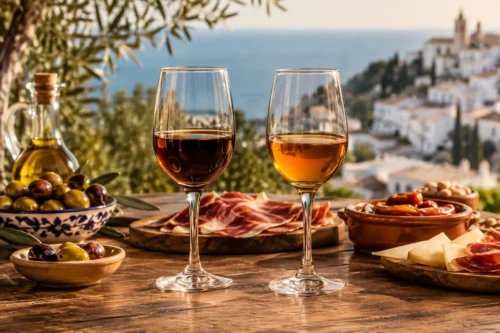
A plate of Iberian ham, a few toasted almonds and a glass of Sherry can be enough to transform an aperitif. But when it comes to choosing, one question often comes up: Oloroso wine vs Amontillado — which bottle best suits your tastes and the meal you have planned?
Both belong to the great family of Andalusian fortified wines, but their ageing processes, aromas and textures tell very different stories.
Oloroso stands out for its depth and full-bodied character. Amontillado often offers a more nuanced profile, combining delicate saline notes with complex aromas developed through ageing. So, it is not a question of choosing a winner: the right choice depends on the occasion, the food being served and the experience you want to enjoy in the glass.
To understand these two styles, it is important to look at how the wine develops in the barrel. In the Jerez region, wines are traditionally aged using a gradual ageing and blending system known as the solera system. This process helps maintain the consistency of a winery’s style while adding complexity to the wines over time.
Oloroso is destined from the outset for oxidative ageing. The wine ages in contact with the oxygen inside the barrel, without being continuously protected by the layer of yeast known as flor. This slow development concentrates its aromas and gives it a colour ranging from amber to mahogany brown, depending on its age and style.
Its name can be misleading: oloroso means “fragrant” in Spanish. It does not indicate sweetness. An Oloroso can be dry, and it is often in this style that it pairs particularly well with food. Sweeter versions also exist, produced or blended according to each producer’s methods. The information on the label remains the best guide.
Amontillado generally begins its ageing journey under flor, like a lighter, more delicate wine. This natural layer of yeast limits contact with the air and encourages subtle notes that are often saline, with hints of fresh almonds, yeast and dried apple. After a varying period of time, the flor disappears or the ageing process moves into an oxidative phase.
It is this second life that gives Amontillado its distinctive personality. It retains some of the freshness and finesse inherited from its initial ageing period, while developing notes of dried fruit, sweet spices and subtle woody nuances through oxidation.
Its name refers to Montilla, another Andalusian region renowned for its fortified wines, although Amontillado is also one of the most iconic styles of Sherry from Jerez.
In the glass, Oloroso typically reveals aromas of walnuts, hazelnuts, dried figs, raisins, dates, fine leather, light tobacco and precious woods. On the palate, it is full, rounded, warm and persistent. A good dry Oloroso can feel almost creamy thanks to its aromatic richness, without necessarily containing a significant amount of residual sugar.
Amontillado offers a more contrasting profile. Typical notes include toasted almonds, hazelnuts, dry caramel, dried herbs, spices, candied citrus and, sometimes, a subtle saline or iodine-like touch. On the palate, it is generally more elegant and refined than Oloroso, with a long, dry finish. Its character can vary considerably depending on the wine’s age, the winery and the length of each stage of the ageing process.
Colour provides an initial clue, although it does not tell the whole story. Oloroso is often darker and deeper in colour, while Amontillado frequently displays amber hues. However, tasting remains essential: two wines bearing the same designation can be very different, with one emphasising freshness and the other concentration.
Amontillado is an excellent choice when you are looking for a gastronomic aperitif that awakens the palate without overwhelming it. Serve it slightly chilled, at around 12–14°C (54–57°F), in a medium-sized wine glass.
It pairs particularly well with toasted almonds, flavourful olives, anchovies, a thin Spanish tortilla or high-quality tinned fish and seafood.
Oloroso is better suited to a more leisurely aperitif, particularly with foods that have bold, intense flavours. Mature cheese, sautéed mushrooms, Iberian cured meats or walnuts provide an ideal setting for its character to shine. Serving it at around 13–15°C (55–59°F) helps reveal its aromas without emphasising its alcoholic warmth.
For an aperitif featuring a selection of small bites, you can serve both styles. Start with Amontillado alongside savoury tapas and seafood, then move on to Oloroso with Iberian ham, cheeses or richer, more earthy dishes. This progression makes the differences between the two wines particularly easy to appreciate.
Oloroso pairs beautifully with slow-cooked dishes, rich textures and roasted flavours. It works particularly well with meat stews, duck breast, pork tenderloin with mushrooms, reduced jus sauces or slow-cooked dishes featuring autumn vegetables. It can also be an excellent match for aged sheep’s cheese.
If the Oloroso is sweet, consider pairing it with desserts featuring dried fruit, caramel or dark chocolate, making sure the dessert does not overpower the wine.
Amontillado pairs particularly well with roasted poultry, mushroom dishes, artichokes, smoked fish and grilled shellfish. Its relative freshness also makes it an excellent match for delicate yet flavourful dishes, such as chicken broth, porcini mushroom risotto or asparagus served with a lightly reduced sauce.
Food pairings are not set in stone. An old, highly concentrated Amontillado can work in some of the same pairings as an Oloroso, while a dry Oloroso served slightly chilled can be a surprising match for a plate of tapas. The key is to balance the intensity of the wine with that of the dish, rather than following a single fixed rule.
Beyond the words Oloroso or Amontillado, pay attention to the style indicated on the label. The term “seco” means that the wine is dry. Some wines also state their average age or use traditional designations associated with extended ageing. This information can help you anticipate whether the wine will have a younger, fresher profile or, by contrast, a more mature and concentrated character.
Also pay attention to the producer and the specific origin when this information is provided. Andalusian fortified wines reflect the work of the winery, the selection of barrels and the time devoted to ageing. For a gourmet gift, pairing a bottle with almonds, olives, Spanish preserves or Iberian ham creates a simple yet highly evocative selection.
If you are buying for a restaurant, bar or delicatessen, it is also worth considering when and how the wine will be served. Amontillado can easily find its place by the glass, as an aperitif or alongside refined tapas. Oloroso is an excellent choice for food pairings, Iberian charcuterie boards and to round off a meal with a selection of cheeses.
Choose Oloroso if you enjoy full-bodied wines, aromas of ripe dried fruit and pairings with rich, flavourful dishes. Opt for Amontillado if you are looking for greater complexity, a drier sensation and an aromatic profile that combines finesse with the character developed through ageing.
To discover Andalusian fortified wines, the best approach is to taste both styles a few days apart, or side by side during a meal. At Andalubox, our carefully selected range of Spanish specialities also makes it easy to create a well-balanced Andalusian aperitif around these wines.
Take the time to serve the wine at the right temperature, prepare a selection of simple, carefully chosen foods, and let each glass naturally find its place at the table.
TE PUEDE INTERESAR
Oloroso wine vs Amontillado: discover their ageing methods, aromas and food pairings to choose the ideal Sherry wine for your table with confidence.